Solar Firm Co-Founder Sees Rising Clout of the Energy "Prosumer"
Speaking engagement
hosted by the San Diego Renewable Energy Society and Global Energy Network
Institute (GENI) highlights the roles that Community Solar, Community Choice
Energy, Peer-to-Peer Solar and the Expansion of Regional and Global Energy
Grids could play in meeting future energy needs. Complete video of the talk can be found here.
San Diego, CA – May 12, 2016 — The next 10 years are going to
bring a host of new energy choices and a lot more market clout for
so-called energy “prosumers” -- utility customers who consume energy but also
produce it, using their own rooftop solar energy systems -- according to
Stellar Solar founding partner, Michael Powers.
In addition to the impressive surge of new solar energy installations in the U.S. – which topped 1 million earlier this month – Powers cited four growing energy trends which are literally putting more power into the hands of solar energy customers everywhere including: 1) community solar; 2) Community Choice Energy or CCE; 3) new progress in peer-to-peer solar energy transactions; and 4) the expansion of regional and even global energy grids, which can move renewable power longer distances to new markets.
“The disadvantage of renewable energy has always been its
intermittent nature,” Powers explained. “Driven by the sun, solar energy
provides more power than you need in the middle of the day and no power at
night. It’s ‘non-dispatchable’ – you can’t turn it up and down to match
customer demands from one hour to the next.” In order to take full advantage of
solar energy’s new widespread popularity, Powers said, there is a need for more
flexible markets and more robust transmission systems to move renewable energy
to where it is needed. As the pool of solar owners grows, he said, these
important market trends are beginning to emerge.
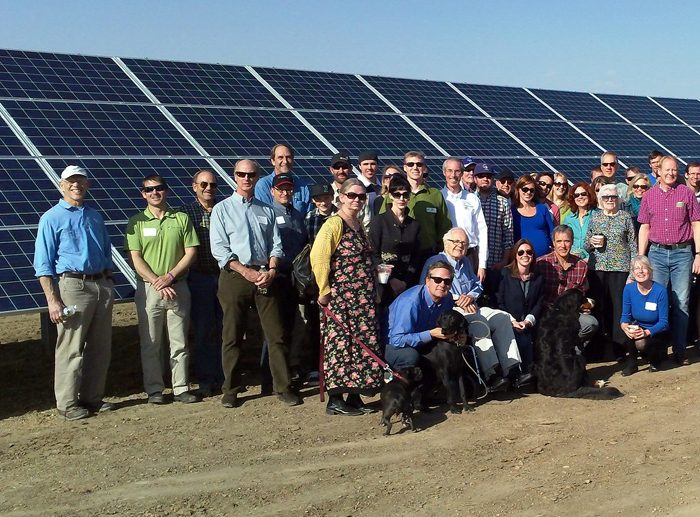 Community solar allows groups of people to invest in
large, shared solar arrays and apply some credits to their power bill; in this
way, apartment-dwellers and lower-income groups can gain access to affordable
solar power. Experts are saying that 2016 could be community solar’s “breakout
year.”
Community solar allows groups of people to invest in
large, shared solar arrays and apply some credits to their power bill; in this
way, apartment-dwellers and lower-income groups can gain access to affordable
solar power. Experts are saying that 2016 could be community solar’s “breakout
year.”
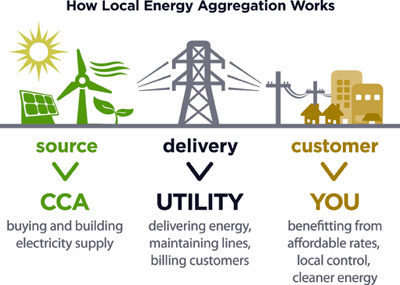 Community Choice Energy (or CCE and formerly known as
Community Choice Aggregation) is a growing trend in California and other states
which allows cities and counties to directly purchase energy on behalf of their
citizens – usually including a higher percentage of renewable energy – and
relegates utilities to simply transmitting and distributing this cleaner power.
Marin and Sonoma Counties
have had CCE programs for over 2 years now, with Lancaster signing on last year and San Francisco
just launched their own CCE program on May 1, called “CleanPowerSF.”
Community Choice Energy (or CCE and formerly known as
Community Choice Aggregation) is a growing trend in California and other states
which allows cities and counties to directly purchase energy on behalf of their
citizens – usually including a higher percentage of renewable energy – and
relegates utilities to simply transmitting and distributing this cleaner power.
Marin and Sonoma Counties
have had CCE programs for over 2 years now, with Lancaster signing on last year and San Francisco
just launched their own CCE program on May 1, called “CleanPowerSF.”
Even more exciting, Powers said, were recent successful
tests of a “peer-to-peer” solar energy trading system in Brooklyn which allows
homes on one side of the street to harvest 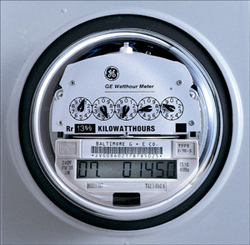 solar energy and sell it to homes on
the other side of the street through a trading system which is independent from
the utility and uses computer software called “blockchain” to keep track of the
monetary value of the trades. “If successful, this could be the 'Uber' of solar
energy,” Powers said, “allowing a solar owner in one time zone to ‘deposit’
solar energy into the system and another one miles away to make an ‘energy
withdrawal’ and the computers will simply keep track of the money.”
solar energy and sell it to homes on
the other side of the street through a trading system which is independent from
the utility and uses computer software called “blockchain” to keep track of the
monetary value of the trades. “If successful, this could be the 'Uber' of solar
energy,” Powers said, “allowing a solar owner in one time zone to ‘deposit’
solar energy into the system and another one miles away to make an ‘energy
withdrawal’ and the computers will simply keep track of the money.”
This practice could someday extend to the global level,
Powers pointed out, thanks to the plans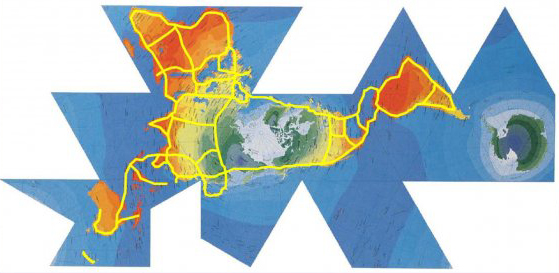 of State Grid Corp., China’s largest
utility, to build a global energy grid over the
next 20 years, a project which will take $15-30 trillion and the participation
of multiple regional power grid operators on multiple continents. Plans were
announced in Beijing and so far,
countries including South Korea,
Japan and Russia have signed on as partners in developing a
pan-Asian energy supergrid to extend as far south as the Phillipines.
of State Grid Corp., China’s largest
utility, to build a global energy grid over the
next 20 years, a project which will take $15-30 trillion and the participation
of multiple regional power grid operators on multiple continents. Plans were
announced in Beijing and so far,
countries including South Korea,
Japan and Russia have signed on as partners in developing a
pan-Asian energy supergrid to extend as far south as the Phillipines.
Quoting experts such as author Jeremy Rifkin, IEEE senior
fellow Clark Gellings and others, Powers said these four developments are all
part of the “digital disruption” that has already impacted industries like
publishing, entertainment, telecommunications and transportation. “The 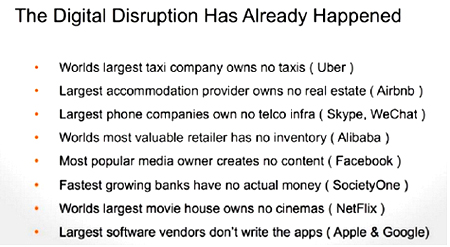 electric
utility industry is simply the next one to be re-invented,” Powers said, “but
the impacts of this change are going to be profound and long-lasting -- because
everything we know runs on energy. When you lower the cost of energy, you lower
the cost of everything.”
electric
utility industry is simply the next one to be re-invented,” Powers said, “but
the impacts of this change are going to be profound and long-lasting -- because
everything we know runs on energy. When you lower the cost of energy, you lower
the cost of everything.”